Visar inlägg med etikett Carter Burwell. Visa alla inlägg

onsdag 28 november 2012

You can hear BD2 Score excerpts tnxs @carterburwell

Photobucket
Here, for demo purposes, are excerpts from the score soundtrack.

torsdag 22 november 2012

Carter Burwell talks about Breaking Dawn Score and "Renesmee's Lullaby"

Photobucket

"The opening title sequence, in which frost blossoms on branches over Carter Burwell's elegant score, is surprisingly stylish." - Robbie Collin, Daily Telegraph, Nov. 14, 2012.
"Condon did several things when he signed on for both halves of "Breaking Dawn." First, he brought his regular collaborators with him, and that is a pretty significant upgrade behind the scenes.  He brought Carter Burwell (who scored the first movie) back to the series to close it out, and Burwell's work is, as one would expect, very strong and often subtle.  He can throw bombast at a moment when it demands it, but he's not just slapping up wallpaper." - Drew McWeeny, HitFix, Nov. 15, 2012.
"Hands-down my favourite part of any Twilight Saga film is the music, and Breaking Dawn Part Two is no exception. Back on board is music supervisor Alexandra Patsavas, who has once again assembled a powerhouse soundtrack with contributions from artists such as Green Day, Feist and Ellie Goulding. Also returning is composer Carter Burwell, who has the Twilight films down to a tee – from the first notes of a rearranged version of Bella's Lullaby at the beginning of the film to the beautiful Plus Que Ma Propre Vie (which fans will recognise as being the Cullen motto)." - Candace Whitehead, iAfrica, Nov. 16, 2012.
"Back for seconds, Christina Perri's catchy ballad 'A Thousand Years' seems to be The Chosen One as far as themes go, outside of Carter Burwell's complicated melodramatic scores. In its coupling of death with love and eternity, it's most representative of the 'Saga,' as well as the dreary optimism of this soundtrack set." - Katie Hasty, HitFix review of the soundtrack, Nov. 12, 2012.
"Bill Condon (Gods and Monsters, Dreamgirls), starts off with a pretty impressive opening title sequence and opening scene, matched well with Carter Burwell's majestic score..." - Ian Kane, Epoch Times, Nov. 15, 2012.

Carter's Notes:

I started writing music for Breaking Dawn Part 2 more than two years before it was released. The director, Bill Condon, suggested that, just as Edward had played "Bella's Lullaby" for Bella in the firstTwilight film, he should now create a lullaby for his daughter Renesmee. This meant that I had to write it before they shot the film, which was happening at the same time as Breaking Dawn Part 1. And, as Rob Pattinson wanted to play it on screen, I had to write something that Rob could play and give him time to learn it.
Only a few weeks before Bill made this suggestion, I learned that I was about to have a baby girl myself. Inevitably I wrote the piece thinking as much about my daughter as about Edward and Bella's. In its way this echoed the story of how "Bella's Lullaby" had been written originally for my wife. For some reason there is a running parallel between my life and Edward's.

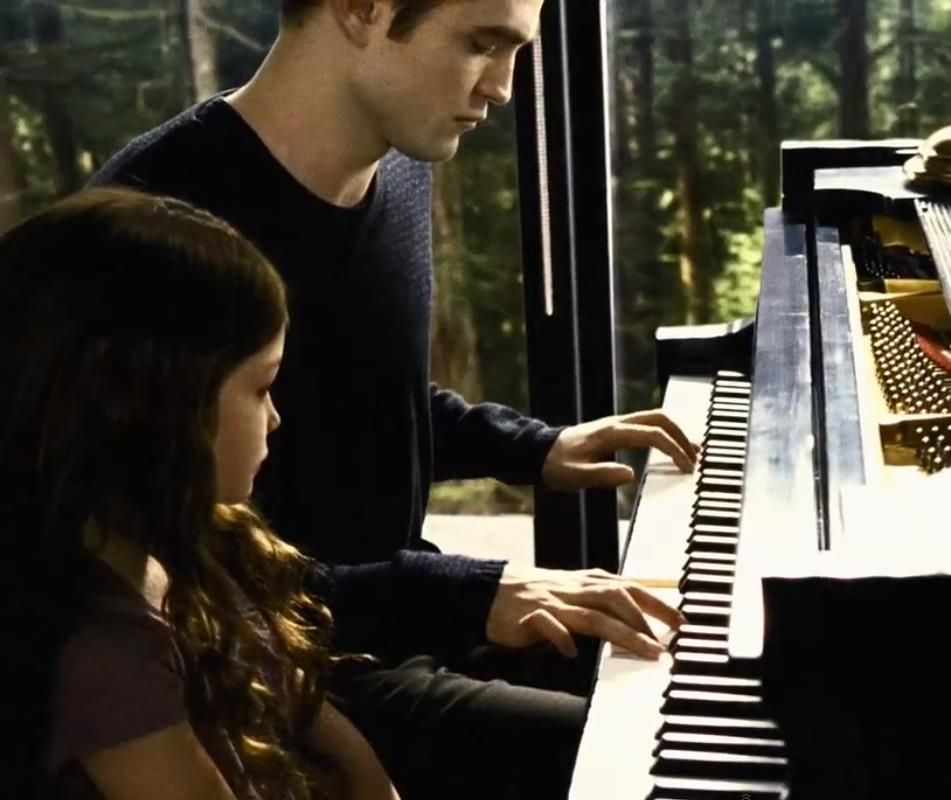
"Renesmee's Lullaby" was hinted at during Bella's pregnancy in Breaking Dawn Part 1, but only really came into its own in Part 2. As Bill saw it, Edward would play it on the piano, as though he were making it up on the spot. Renesmee, who grows very quickly and has unknown but prodigious powers, would sit at the piano with her father, appearing to be five years old. She joins in and they develop the piece for four hands. As they do so, the scene shifts to Volterra, Italy.
The piano music continues, but is joined by the gothic music of the Volturi, the vampires who oppose Edward's coven, as Irina tells them about Renesmee's existence, setting in motion the great conflict of the film. At the end of the scene we cut back to the Cullens and the piano music continues, but now Renesmee appears a few years older and is playing the piece by herself, with great skill. This sort of audiovisual storytelling in one of Bill Condon's specialties. A complex story encompassing multiple characters, locations and times is told compactly by overlapping scenes, using music as connective tissue.


As I mentioned in my notes for Part 1, this score was treated as true melodrama, with music playing every thought and feeling, every raised eyebrow and decapitated head. There is almost 90 minutes of score in Part 2, and again the sheer quantity was challenging. But there were several differences between this film and the ones that preceded it that went beyond the numbers.

First, there are almost no true humans left in the story. Bella's dad enters the story briefly, but is the only human involved. Every one else exists on a supernatural plane. No one is faced with human limitations or doubts. This is most striking, perhaps, for Bella. She is completely at ease with her new powers as a vampire, in ways she never was as a human, so the awkwardness that in many ways defined her character, and which was often central to the sound of the first film, is all gone.

Second, many new characters enter the story. The Cullens go around the world recruiting allies for their conflict with the Volturi. Literally dozens of new vampires are introduced. I didn't attempt to write specific themes for all of them, although I did for some. However, the new characters did allow for changes of tone which helped keep the music varied.

Lastly, the film ends with an unabashed over-the-top action sequence that takes up almost 30 minutes of screen time. This required a different type of score than any of the previous films. Characters fly through the air, rip each other's heads off, open fissures in the Earth and leave the ground littered with bodies. The music grows much larger than it has before - symphony orchestra, choir, electric guitar, plus a battery of percussion.
I don't have that much experience as an "action" composer, and it was challenging to keep the tension and pace ever-increasing for long periods of time. I could never have done it without the help of my colleagues - Chris Willis, Adam Smalley, Sonny Kompanek and John Thomas. In the end, I feel we managed to bring it all to a satisfying climax, but I guess I have to watch all the films back-to-back to know if that's really true.

Source: thebodyinc

söndag 11 november 2012

Carter Burwell discusses ‘The Twilight Saga: Breaking Dawn – Part 2’, Part 1


The moment has inevitably come to pass; “The Twilight Saga” film franchise has drawn to a close. But it has made such an impact on popular culture that it will influence Hollywood for years to come. And a large part of the viability of these films stems from the musical backdrop. Through the five films, three composers have made their mark with brilliant atmosphere, poignant characterization, and palpable romantic energy.
(..)

One of the things I have really enjoyed about the “Twilight” film scores is the idea that they could very easily become these overtly-dramatic and dreary depression-fests that would otherwise be difficult to listen to as a musical product, but you seem to go out of your way to inject surprises and left-of-center musical decisions to make them fun and to keep the listeners on their toes. I’m speaking specifically to things like the horror element in ‘What You See in the Mirror’ (in “Breaking Dawn – Part 1”) and that wild swagger in ‘A Yankee Vampire’ (in “Breaking Dawn – Part 2”).
I will say right away that it’s a challenge for me to write music that never stops in the films; especially these last two “Breaking Dawn” films. They are like traditional melodramas, where one piece of music is ending, another one is beginning, and music plays through almost everything. For “Breaking Dawn – Part 2,” there was almost 90 minutes of scoring – there really is music playing all the time. So, what I do to make it palatable for myself is to keep it changing as much as I can and finding different tonalities.
And sometimes, we take that melodrama and try to make a joke out of it and go completely over-the-top, or I try to throw in something unexpected. For example, one of the things that happen in “Breaking Dawn – Part 2” is the introduction of dozens of new characters; there are vampires from all over the world coming together. And it’s not possible to write a new theme for every single character.
But ‘A Yankee Vampire’ was written for a character named Garrett, who talks about having been present at the Revolutionary War, but he dresses more like a member of a rock ‘n’ roll band. So, with the music, I tried to combine Americana with early rock ‘n’ roll. I was reaching for these strong musical tags that I can put on some of these characters that come and go very quickly. There are just so many things going on and so many characters in this film that it becomes the norm. And it’s just one of those things that I do to try to keep things varied and from sounding the same.
On these “Twilight” film soundtrack releases, you contribute one piece of music to each of them. For “Breaking Dawn – Part 1” you created ‘Love Death Birth’, and for “Breaking Dawn – Part 2” you offered ‘Plus Que Ma Propre Vie’ [French for ‘More Than My Own Life’]. Were these written before the scores, or were they compiled specifically for the soundtracks?
Those were compiled for the soundtracks, and I have mixed feelings about them. On the first “Twilight” soundtrack album, they weren’t originally planning to put anything of mine on there. But once ‘Bella’s Lullaby’ was written and recorded, it was such an important aspect of the film that Catherine Hardwicke, the director, really thought it should be on the soundtrack. And I think that made perfect sense.
But subsequently, every composer (including me) has put a piece on the soundtrack album. And I really don’t see how they go along with the songs. They don’t seem to mingle well with the songs, if you ask me. I guess it had just become a tradition with the “Twilight” series, and when we came to these last two films, they asked me to create suites to include, so I did it.
Well, what I like about them, especially these last two, is that there seems to be a tone poem quality to them, and I don’t know if I’m looking at them too philosophically or what. But ‘Love Death Birth’ really seemed to symbolize Bella’s transformation or growth into what or who she is now. And ‘Plus Que Ma Propre Vie’ starts with the end of that and pulls back, showing that she is merely a cog in a wheel and not as much a major component to the grand scheme she may have thought she was.
That’s interesting. I like your interpretation, in particular ‘Love Death Birth’ – there is a certain shape to it that does parallel Bella’s experience in that film. I have a harder time finding a shape like that with “Breaking Dawn – Part 2,” but I will accept your explanation…it’s as good as any I’ve got about what that piece means.
Now that the “Twilight” road has come to an end, looking back, would you have liked to have contributed to “New Moon” and “Eclipse”?
Yes, yes I would have. Seeing the entire set of films as one set of experiences, I would have liked to have participated in that journey. When we came to “Breaking Dawn – Part 1,” there were characters we hadn’t addressed in the original “Twilight” – Jacob barely had any musical identity or theming. He had grown into his own character during “New Moon” and “Eclipse.” I really would have liked to have been a part of developing his character. But at the same time, it doesn’t bother me that much that I wasn’t there.
’m so happy that once Bill Condon was chosen to direct these films that we could do this together. Honestly, a lot of the fun of doing these films has been working with the directors. I hadn’t really worked with the directors for “New Moon” and “Eclipse,” but it was a great pleasure working with Catherine on the first one and Bill on these last two. It might have been fun to do the others, but I have no regrets.Full interview examiner


Photo

torsdag 19 juli 2012

First-look at 'Breaking Dawn Part 2' Score by Carter Burwell

Photobucket

Here's a first-look at The Twilight Saga: Breaking Dawn - Part 2's official motion picture score, by Carter Burwell, brought to you by Jack Morrissey, he who deals out the Twilight fan goodies so faithfully.

As Morrissey explained in his latest "Team Jack" Q&A session, director Bill Condon and Burwell were in London, England last week at Abbey Road Studios working on the score, which is why Condon was unable to return for this year's Comic-Con event in San Diego to spotlight Breaking Dawn - Part 2.

Carter Burwell, of course, composed the scores for Twilight and Condon's The Twilight Saga: Breaking Dawn - Part 1 and returns to close out the Saga with Part 2.

Burwell is known to have composed "Bella's Lullaby" for Twilight, which made a reappearance later in the Saga, and he's said to followed up with "Renesmee's Lullaby" for Robert Pattinson to perform on the piano during Part 2

Source: examine

söndag 4 oktober 2009

47 days til New Moon hit theatres all over the world

With only 47 days to go til the world premiere it's time to refresh your Twilight memory (as if you would need any of that).
Found this youtube clip on Bellas lullaby by Carter Burwell feat some pretty nice screencaps from the Twilight movie:

Sv: Med endast 47 dagar kvar till världspremiären av är det dags att uppdatera ditt Twilight minne (som om du skulle behöva något av det).
Hittade det här klippet på youtube, Bellas Lullaby av Carter Burwell med en hel del schyssta scenklipp från Twilight filmen:

Related Posts Plugin for WordPress, Blogger...