Visar inlägg med etikett movie review. Visa alla inlägg

söndag 11 november 2012

[Scans] Reviews of Cosmopolis and Bel Ami in the newspapers "Clarín" and "The Nation" (Argentina)

Cosmopolis Review:

Photobucket Photobucket Photobucket

Bel Ami Review:

Photobucket Photobucket

Via lasagarobsten / pattinsonworld
Source: allyouneedisrob

fredag 7 september 2012

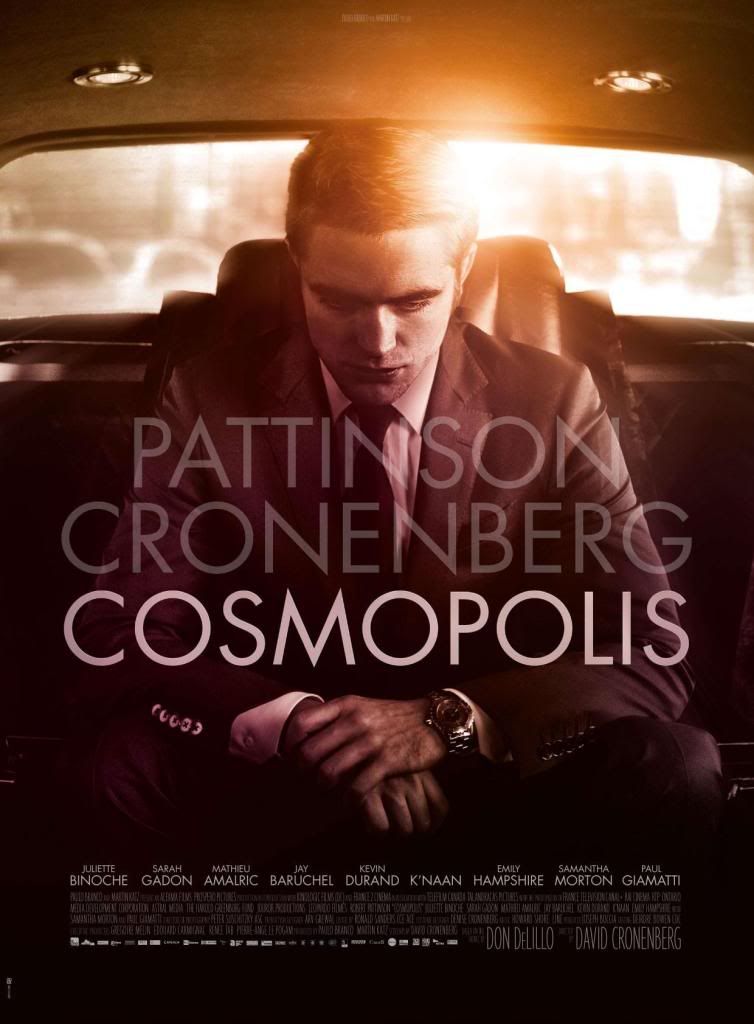
New 'Cosmopolis' Review: The Movie Is A "Mixed Bag"

Photobucket

"It’s hard to know what to make of “Cosmopolis.”

Is it an icy cold, lacerating and prescient look at what our society has become in the wake of the economic meltdown? A pretentious muddle championing form over substance? A meandering collection of set pieces loosely held together by a decidedly odd, distancing performance, most of which takes place inside a stretch limo?

Yes.

All that and probably more, too. David Cronenberg’s film, based on the Don DeLillo book, stars Robert Pattinson as a billionaire trying to make his way across Manhattan to get a haircut. This as his world is tumbling around him. The pairing of Cronenberg’s style with DeLillo’s words — the director has said that the dialogue comes basically verbatim from the book —- sounds, on paper, like a dream pairing. 

It’s not clear that it is. In fact, some parts of the film fall so flat in such odd ways you wonder what Cronenberg is up to. Then another scene will come along and you will think that it redeems not only whatever came before it but the film itself. Sometimes you wonder if Pattinson is purposely removing himself emotionally from the proceedings (likely) or if he’s just not much of an actor (benefit of the doubt, all that). Happily for everyone involved, it ends on the strongest note of all, a lengthy scene with Pattinson and Paul Giamatti.
“Cosmopolis” is frustrating, funny, thought-provoking, weird, maddening, worthwhile. It isn’t a great movie. Sometimes it’s not a good one. Sometimes it is. Ultimately it is one worth working through, a valuable exercise if you’re willing to make the effort."

Source:  news-leader

fredag 25 maj 2012

"On The Road'' Review by Little White Lies

Photobucket
 
The false promise of the post-war American dream under Harry Truman’s Fair Deal left a generation of young dreamers searching for a different joie de vivre on the open highways that stretch like taut arteries from coast to coast, carrying new blood in no particular direction.
No one captured that sense of urgency, opportunity and impulse better than Jack Kerouac, whose largely autobiographical 1957 novel (written in 1951) – with its erratic prose and sprawling narrative – became a beacon of Beat-era nonconformity. Just as the Kerouac backlash has steadily gained momentum since the novel’s original publication, however, so a shroud of apprehension has slowly begun to descended on Walter Salles’ adaptation since filming wrapped in late 2010.
In truth, the journey to bring ‘On the Road’ to the big screen has been dogged by false starts and mixed fortunes ever since Francis Ford Coppola bought the rights in 1979. But, now that Garret Hedlund’s wild, seductive transient, Dean Moriarty, and Sam Riley’s struggling writer trying to take off, Sal Paradise, have finally arrived, has the wait been worth it?
Well, as far as Hedlund and Riley are concerned at least, On the Road ticks a lot of the right boxes. Both possess a magnetic screen aura that’s essential in sustaining any surface interest in their episodic cross-country bromance. Yet while their drug- and sex-fuelled sampling of New York’s jazz cafes, San Fransisco’s counterculture scene and everything the great American Mid West has to offer in between is undoubtedly lifted by this dynamic pairing, the novel’s central theme of challenging 1940s masculinity is criminally lost.
Salles gives arguably the two most important characters, Moriarty’s on-again-off-again teen bride Marylou and his older, more domesticated sweetheart Camille, to Kristen Stewart and Kirsten Dunst respectively. Shrewd casting, but the culturally emblematic roles of these women (one promiscuous temptress, the other wholesome matriarch) is obscured, and as a result the catalytic power gains and losses between Sal and the girls over Dean’s affections seem trivial.
With a romantic like Salles at the wheel we weren’t expecting On the Road to hold a mirror to today’s disenfranchised American youth. But we weren’t expecting such a tedious, flat film either. Ultimately that’s the price for failing to tone down the narcissistic, shallow tendencies of the characters – although it doesn’t account for just how few memorable scenes there are (with the exception of K-Stew’s boobies and Hedlund nailing a sherried Steve Buscemi).
You can keep the Zeitgeist embalmed in myth and nostalgia for as long as you like, but to truly reinvigorate it you’ll need a whole lot more than a whiskey-hued lens and a frontseat full of pretty faces.
 

Three New Cosmopolis Reviews

Photobucket
"Cosmopolis" Review by Little White Lies

David Cronenberg’s superb latest is an existential road movie for our financially and morally bankrupt times, interested as much in addressing the semantic minutiae of the corporate apocalypse as it is deep felt anxieties relating to stress, success, control and our inability ward off death with money and status.
Like The Social Network, it combines a credible depiction of a person whose age and intellect are dangerously off kilter, while sending its ‘hero’ on an anti-capitalist nightmare odyssey that discharges all the dry cynicism and insouciant doomsaying of Godard’s Week End.
Very neatly abridged by Cronenberg himself from the 2003 novel by American postmodernist writer, Don DeLillo, his screenplay filets out much of the dialogue from the source while expunging the flashbacks, dreams and internal monologues.
Robert Pattinson is magnetic as Eric Packer, slick, jaded 26-year-old CEO of Packer Capital who decides to take a fleet of Limousines across across New York City in search of a haircut. This is his best performance to date by some considerable margin. Yes, even better than Remember Me.
But there’s something strange about this idle whim. Eric is a man to whom people and services come, not the other way around. As his loyal security guard, Torval (Kevin Durand), says, he could have a barber come to the office, or even to the Limo. During a single day, Eric experiences an Icarus-like fall from grace while numerous acolytes and paramours visit him in his cab to chat numbers, health and even the sudden death of rap megastar, Brutha Fez.
People want Eric dead, or in the case of Mathieu Amalric’s mad Andre Petrescu, to throw a pie in his face. He has become a walking wanted poster for the corporate scourge who cheerfully wipe out millions with a few swipes of touchscreen computer. For Eric, murder is also starting to shed its taboo status.
It’s a richly verbose film, even more so than his majestic, 2011 exploration of extreme emotional repression, A Dangerous Method. It gets to the point where much of what is spoken cannot be fathomed – “talent is more erotic when it’s wasted” – but the film is about the rhythms of dialogue, the verbal posturing, sparring and deceptions employed in the economic sector.
The way in which Cronenberg photographs the talk, too, is subtle, elegant and intense without ever drawing undue attention to itself or feeling overly oppressive. Per Cronenberg himself, this is a film in which “fantastic faces say fantastic words”.
Beyond its withering critique of contemporary capitalism, Cosmopolis is also fascinated by that ongoing Cronenbergian concern: the limitations and mutations of the human body. Eric desperately wants to scale an economic Mount Olympus and be able predict the permutations of the Chinese Yuan, and his inability to attain this level of cerebral perfection acts as a signifier for his mental and physical decline.
In one scene, Eric has a prolonged rectal examination after which he is informed that his prostate is asymmetrical. In a climactic showdown with a disgruntled, pistol-wielding ex-employee (Paul Giamatti), this small bodily imperfection becomes the key to understanding Eric’s meltdown.
This film clocks up the astronomical price of achieving so much at such a young age, when your body and mind reach a state where there is no reason left for them to function.

"Cosmopolis" Review by Empire
Somehow David Cronenberg's Cosmopolis articulates everything I think about post-financial crisis capitalism, ie, the world today. It goes without saying that it is weird, but even from the director of eXistenZ and Videodrome it is bizarre, with the mannered, affected performances of the former and the outsider characters of the latter. It doesn't quite fit with the early body-horror movies but there is, like A Dangerous Method, a viral metaphor at play here, and this time the virus is not free thought but the free economy (towards the end of the movie, Robert Pattinson's vampiric playboy comments that “nobody hates the rich, everybody thinks they're ten seconds away from being rich”). But what is money? Is it the dollar? The baht? The dong? Could it be a rat? A live rat, a pregnant rat or a dead rat? What does money even mean?
Cronenberg's cool, intelligent film asks all these questions – literally – and more, then goes even further, asking: what does meaning mean? Seriously. Even by the director's lofty standards this is a talky film, and most of it goes round in circles. As promised, it concerns a limo ride to get a haircut, but Cosmopolis – based (to what extent I have yet to find out) on Don DeLillo's novel – is a surprisingly roomy affair, and not simply a one-set gimmick. In some senses it resembles Godard's Weekend, since the traffic is terrible and civilisation seems to be crumbling outside it, but this will also play well to genre fans and is definitely one of Cronenberg's most ambitious movies to date.
For Robert Pattinson, however, this is another league, and his celebrity status certainly suits the part. He plays Eric Packer, son of a super-rich businessman, a society kid who has made his fortune with mysterious dotcoms and by playing the money markets. Today he is betting against the baht and losing hundreds of millions of dollars in the process. The inside of the limo glows with LED screens, and Eric is joined by a roundelay of guest stars (including a very slinky Juliette Binoche and, more surprisingly, an edgy Samantha Morton) who engage him in bizarre, solipsistic conversations. These talks border on self-parody but somehow they work. It reminded me of Roy Andersson's wonderful Songs From The Second Floor, since this is what the end of the world probably would sound like. Though the budget is clearly quite low, Cronenberg does convincingly convey a sense of apocalyptic doom, from his characters' psychotic babble (at one point Eric is attacked by the custard-pie wielding Pastry Assassin) to a full-on riot that covers the pristine car in spraypaint and anti-capitalist graffiti.
The stylised nature of the language will limit this film's appeal, and its self-conscious craziness might also be testing to some (why does the professional barber Eric finally visits cut huge steps in his hair?). And after Water For Elephants it remains to be seen whether Pattinson's teen following really is willing to follow him anywhere. But Cosmopolis does prove that he has the chops, and he parlays his cult persona beautifully into the spoiled, demanding Packer, a man so controlling and ruthless that only he has the power to ruin himself. Lean and spiky – with his clean white shirt he resembles a groomed Sid Vicious – Pattinson nails a difficult part almost perfectly, recalling those great words of advice from West Side Story: You wanna live in this crazy world? Play it cool.
 Credit Empire / Via  @larry411

"Cosmopolis" Review by the Playlist
"Cosmopolis," an adaptation of Don DeLillo’s typically provocative novel of the same name, is the first feature film since 1999's "eXistenZ" that filmmaker David Cronenberg has directed and scripted. This in part explains why "Cosmopolis" is such a triumph: it’s both an exceptional adaptation and a remarkable work unto itself.
Cronenberg makes slight but salient changes to DeLillo’s source narrative. These changes, which are best described by one character as “slight variation[s],” prove that Cronenberg’s given serious consideration to what should and shouldn’t be represented in his adaptation of the author’s ruminative, conversation-driven narrative. For example, in Cronenberg’s film, Eric Packer (a surprisingly adequate Robert Pattinson), an ambivalent and self-destructive power broker, does not get to have sex with his wife like he’s wanted to do throughout DeLillo’s book. Other changes, like the fact that Packer is investing and studying the steady rise in the Chinese yuan in the film and not the Japanese yen, as in the book, are equally striking. These differences noticeably enrich DeLillo’s original story, making Cronenberg’s "Cosmopolis" that much more rewarding in its own dizzying way.
It’s fitting that Pattinson, today’s It boy, plays Packer, considering who Cronenberg’s Packer is. As a former start-up wunderkind, the 28 year-old Packer is comically death-obsessed. “We die every day,” he risibly exclaims to one of his sizeable retinue of advisors. Packer gets daily check-ups from his doctors partly because he enjoys the routine of it but also because he’s looking for something to confirm his suspicions. He’s convinced he’s found that something when he’s told that his prostate is asymmetrical. It’s pretty funny to see Pattinson, being the young, pretty tabula rasa that he is, play Packer, a wheeler-dealer that used to be hot shit but is now unable to sleep because he fears that he’s no longer relevant.
Throughout both versions of "Cosmopolis," Packer searches for a break in his routine. Against the advice of his over-protective bodyguard Torval (Kevin Durand), he fights back anarcho-protestors and gridlock traffic caused by the President’s visit to another part of town, so he can go get a haircut. The ritual, and also the familiarity of this ritual, is what matters to Packer. But Packer also insists on going out and getting his haircut now because, as he explains during one of many declamatory speeches, of the turbulent conditions Torval has warned of. He’s no longer waiting on his death, he’s inviting it.
Packer is in that sense, as is also later explained point-blank in a speech, a contradictory figure. For example, he allows Vija Kinski (Samantha Morton), one of the more decisively outspoken of his advisors, to tell him that the anti-capitalist protestors that are impeding his progress are actually just another part of the capitalist system. Pattinson’s Packer latently agrees with this assessment but that changes when he sees one protestor self-immolate himself. Kinski insists that the protestor’s gesture is unimportant, but Pattinson sulkily protests that it has to be. The fact that Pattinson’s practically pouting when he rejects Morton’s negative assessment is telling. His death wish is sheer petulance, something that doesn’t come across as directly in the original novel.
Cronenberg and Pattinson’s Packer is a different kind of suicidal but their character isn’t significantly less active in constructing his own demise. In DeLillo’s "Cosmopolis," Packer knows what’s happening with the yen, whose value keeps exponentially increasing, but is keeping that knowledge close to his chest. In Cronenberg’s variation, Packer is less sure. Pattinson’s Packer is thus more immediately defined by his frustration with the finite-ness of his capabilities. He looks to others for solutions to his problems and finds that his yes-team can only confirm his own impotence. The film version of Packer is not slyly organizing his own downfall, he’s frantically seeking it out, unsure of whether or not he can find what he’s looking. Pattinson’s Packer only succeeds by sheer dumb luck: an assassin is looking for him and he and Packer have a lot more in common than the two realize.
At the same time, Cronenberg doesn’t slim down DeLillo’s simultaneously sprawling and precisely dense narrative as much as he carves his own flourishes onto it. A couple of scenes, including Packer’s interest in bidding on a chapel full of art, and his visit to a night club full of drug-fueled ravers, are only necessary to establish a uniform pace to Cronenberg’s narrative. But in that sense, these scenes are just as essential as the ones where Kinski and Torval give Packer advice. Everything matters in Cronenberg’s "Cosmopolis," but not everything is necessarily the same as DeLillo’s book. And that makes the film, as a series of discussions about inter-related money-minded contradictions, insanely rich and maddeningly complex. We can’t wait to rewatch it. [A]
  Credit  The Playlist / Via  @ThinkingofRob

fredag 10 september 2010

Another 'The Runaways' Movie Review


As it hits this side of the Atlantic this week, The Runaways will find itself on the back foot. Not because this is a terrible film - it definitely isn’t that - but because the audience for a biopic of a 70s band that most people will have to Google is going to be fairly limited. To be fair, The Runaways did feature Joan Jett who went on to achieve fame with “I Love Rock N’ Roll” but still this is the problem with American rock biopics - they’re always about bands you’ve completely forgotten.

The Runaways achieved VERY moderate success in the mid-to-late 70s. They were an all girl group put together by Kim Fowler (Michael Shannon) who was the wrong side of crazy but definitely had an ear for a good song and knew a marketing opportunity when he saw one. This film focuses its attentions on lead singer Cherie Currie (Dakota Fanning) and her relationship with songwriter and guitarist Joan Jett (Kristen Stewart) with the rest of the band acting as wallpaper.

Having picked up Cherie in a nightclub as they searched for a blonde bombshell in the vein of Bridget Bardot, Joan and Kim set about turning Cherie into a rock star. Initially, she’s too timid. Not that I blame her really - I doubt very many people who be happy with their manager paying kids to fling dog turds and bottles at them while they practice. Kim knows what he’s doing, however, and very quickly pushes the right buttons to bring out Cherie’s inner rock chick with the band’s biggest hit “Cherrybomb” and once that happens there’s no stopping her. Despite being all of 16 years old she embarks on a series of sexual liaisons with the band’s roadie and Jett (the rather tame sex scenes between Stewart and Fanning have been sold as one of the film’s main attractions) and begins the drinking and drug-taking that will lead to her inevitable downfall. Meanwhile Jett who indulges in all these things as well but knows a thing or two about moderation is quietly laying the foundations for a solid long term career in music.

Unfortunately for The Runaways, it is hampered by the fact that the story of the band is pretty much the story of every band. They get together, find out that they rock, achieve moderate success whereupon the front man (or woman in this case) starts getting notions about themselves - emboldened of course by copious amounts of white powder - and things start to go pear-shaped. Cliches exist for a reason, I suppose. Still, for the first hour or so as the band get together and Cherie’s ego starts to develop, the Runaways is an exhilarating ride. And the soundtrack is brilliant - almost worth the ticket price alone.

Stewart, doing her best to break free of the yoke of Twilight, is very good. That permanently sullen expression and that she wears is perfect for the cool, rebellious Jett. Indeed, one of the film’s major flaws is that there just isn’t enough of her. Writer-director Floria Sigismondi clearly decided that Cherie’s journey was the more interesting story (to be fair, it is based on Cherie’s memoirs) but Stewart‘s Jett is sidetracked as a result. Fanning is an accomplished actress, of that there is no doubt, and she delivers a mature, measured performance as Cherie presses the self-destruct button. Still, it‘s hard not to feel that this is a little bit too left field for her - I’m not suggesting that she spend the rest of her career playing adorably cute, sweet natured pre-pubescent teens but this is probably a couple of steps too early in the difficult transition from child stardom. Taking on a role that requires her to dabble in drugs and promiscuity with both men and women is a bit too deliberately in your face for my liking. Elsewhere, Shannon gives a suitably manic turn as the flamboyant Kim which makes you wonder how this band every made it in the first place.

It’s a pity really that the story of The Runaways is so conventional because the band itself definitely wasn’t and the film ends up suffering as a result. Still, with an excellent soundtrack and sound performances from the three main players, The Runaways may not be the (cherry) bomb but it’s definitely worth a look.

Stars: ***

Review by Gareth Naughton

torsdag 1 juli 2010

KURT LODER: ‘Eclipse’ Best of ‘Twilight’ Films; Still Not Very Good

Photobucket

"Eclipse" might be as good as the "Twilight" films are going to get. The main actors have settled comfortably into their roles in this third installment of the franchise. Jackson Rathbone, Nikki Reed and Ashley Greene, the more interesting of the home-team vampires, have a welcome new prominence, and Robert Pattinson even has a scene in which he displays a twinge of character-development. The movie also has some actual action, as everyone must know by now — a big vampires-versus-vampires-versus-werewolves battle sequence at the end of the picture.
However, having imposed something like narrative clarity on the story, new director David Slade is still stuck with the story — which, deriving as it does from the paceless goop of Stephenie Meyer's books, and having been wrestled into a script by Melissa Rosenberg, is a threadbare quilt of pre-teen romantic clichés padded out unconscionably with long character flashbacks and rambling dialogue that's deader than any of the vampires in attendance. (The picture runs two hours, and might have been more enjoyable — and certainly less exasperating — if it had been cut down into a one-hour TV special.)
We begin where the last movie left off, with chaste young lovers Bella Swan (Kristen Stewart) and Edward Cullen (Pattinson) nuzzling in a sunlit flowery field. She's reading him poetry. He's glistening a bit, as the "Twilight" vampires ridiculously do whenever they're out and about in the daytime. He asks her to marry him. "Change me," she replies — meaning, turn her into a vampire, too. He doesn't want to do this. But we already know that, and we wish he'd just get over it and get it over with, because we've been through this wearying routine before, and we know lots more of it lies ahead.
Bella's dad (Billy Burke) doesn't like her hanging out with Edward so much. Why can't she spend more time with the other kids, like that nice Jacob Black (Taylor Lautner)? Jacob, of course, as we also know, is a member of the local werewolf clan, and he's in love with Bella, too. Possibly in vain, though. "I don't feel that for you," she says. "I don't buy it," he snaps. Then he tries to kiss her, and she punches him in the face. (And sprains her hand — werewolves are very ... hard, or something, apparently).
You could count the minutes Lautner doesn't spend topless in this picture on the hands of a cartoon character. ("Doesn't he own a shirt?" says Edward, deploying one of the movie's several self-aware wisecracks.) This is an understandable strategy on the part of the filmmakers, since Lautner, a formidable physical specimen and a mildly appealing presence, does most of his acting with his abs. (True, he hasn't been given a lot to work with by the script, but who here has?)
Jacob and Edward's territorial sniping over Bella continues even after the need arises for both of their families to band together against an attack by the rogue vampire Victoria (now played by Bryce Dallas Howard) and her army of "newborns" — vampires who've only recently been turned. Here we puzzle once again at Stephenie Meyer's complete indifference to traditional vampire lore — to the basic characteristics that make these creatures fun. Apart from the fact that her bloodsuckers can walk around in the sunlight and have no fangs, we're now informed that newborns are the most powerful of all vampires because they still have traces of human blood running through their veins. Traditionally — logically — the most ancient vampires are the most powerful. And anyway, don't most vampires have human blood coursing through them? Isn't human blood what they live on? The contending vampire contingents in this movie could as easily be rival biker gangs or feuding hillbilly families with little adjustment required in the story.
This brings us once again to the sex question. There comes a scene where Bella and Edward are canoodling on a bed, and she asks him — begs him, actually — to have sex with her. But after a quick montage of button-fumbling, Edward backs away. "Believe me, I want to," he says. "I just want to be married to you first." Then he says, "I'm from a different era." If I had to guess, I'd say that era was the 1950s, when sex, if it happened to rear its troublesome head, was consummated offscreen, following a tasteful fade-out. In the "Twilight" films, carnal possibilities aren't even implied. No one's saying that Bella and Edward should get naked, in the manner of HBO's immeasurably superior "True Blood" series. But their dinky cuddling and cooing has no erotic charge. It's like a pepperoni pizza without the pepperoni. It's all cheese.
Just as our patience with this picture is about to collapse — following mini origin stories for two of the Cullens, and a meandering campfire chat with the tribal elders of the Black clan, and a scene in a tent with Bella, Edward and Jacob that may still be going on, for all I know — we finally get the big battle between the local vampires and werewolves and Victoria's invading army of newborns. The werewolves are meticulously animated CGI (although as always in "Twilight" land we wonder how guys in pants can transform into pantsless wolves and then transform back again to guys in pants). But the battle itself is oddly earthbound — the two groups of antagonists simply charge across a field at each other and collide. There's lots of thrashing and gnashing and flying through the air, but what this smackdown summit of vampires and werewolves boils down to is a big street rumble.
The people behind the "Twilight" films clearly feel that fans will sit through anything that brings the books they love to the screen. I wonder how long that'll hold true, though. Could this really be as good as the series is going to get? Without ever getting good?


source

måndag 28 juni 2010

Variety and The Hollywood Reporter Give ‘Eclipse’ Positive Reviews

Reviews are slowly but surely pouring in for The Twilight Saga: Eclipse, and by the looks of the reviews put out by outlets Variety and The Hollywood Reporter, we have a success on our hands! Variety boasts that while hardcore fans will be pleased, non-fans will love it too! The Hollywood Reporter follows a similar path and boldly states that “it took 3 films, “The Twilight Saga” finally nails just the right tone”. Read more below: (Warning, full reviews contain spoilers)


Photobucket


The Hollywood Reporter Reviews The Twilight Saga: Eclipse:

It took three films, but “The Twilight Saga” finally nails just the right tone in “Eclipse,” a film that neatly balances the teenage operatic passions from Stephenie Meyer’s novels with the movies’ supernatural trappings.

Where the first film leaned heavily on camp and the second faltered through caution and slickness, “Eclipse” moves confidently into the heart of the matter — a love triangle that causes a young woman to realize choices lead to consequences that cannot be reversed.

Read the full review by THR here.
Variety Reviews The Twilight Saga: Eclipse:

It goes without saying that the faithful will devour “The Twilight Saga: Eclipse,” the third movie in Stephenie Meyer’s immensely popular supernatural love-triangle saga, and also the one in which Bella must finally choose between her two beastly suitors. The pleasant surprise this time around is that the result finally feels more like the blockbuster this top-earning franchise deserves. Employing a bigger budget, better effects and an edgier director (“Hard Candy’s” David Slade), “Eclipse” focuses on what works — the stars — even as the series’ parent-friendly abstinence message begins to unravel. Summer release should reap Summit’s biggest yield yet.

Read the full interview from Variety here
twilightersanonymous
Related Posts Plugin for WordPress, Blogger...